Before You Pay $3,000–$4,000 to "Understand" Your Own Estate Plan, Read This
For anyone researching wills and living trusts who's priced — or is dreading pricing — an attorney, and wants to know what actually works before spending another dollar or another year putting it off.
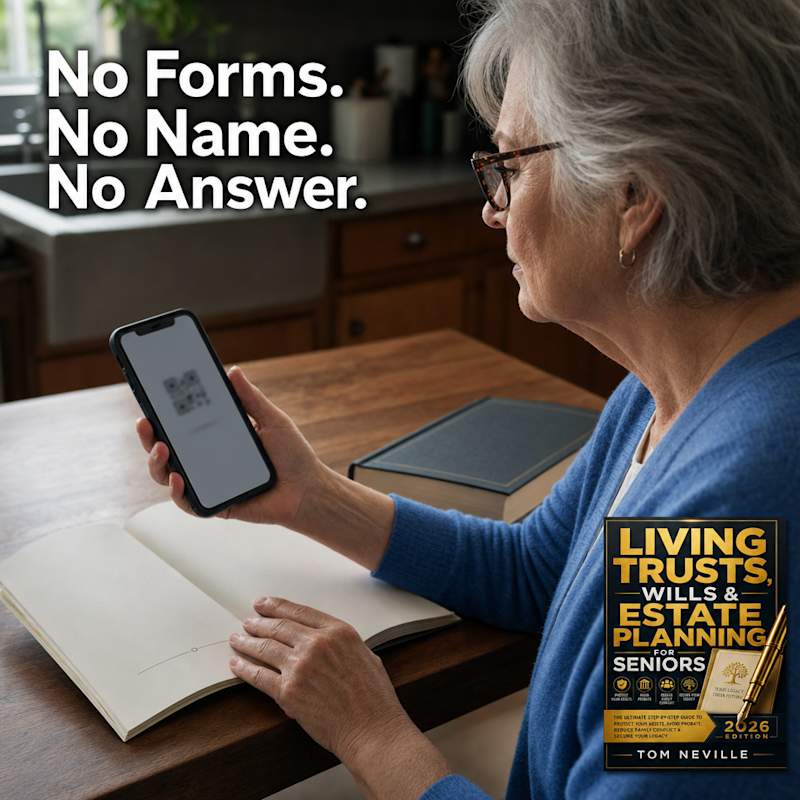

You've priced it. Maybe you've even sat across from someone in a nice office who quoted you somewhere between $3,000 and $4,000 — for "a simple trust." Maybe you haven't called anyone yet, because you already suspect that's roughly what it'll cost, and you'd rather not know the exact number.
Either way, you're stuck at the same place a lot of people are stuck: you know you should have a plan. You don't have one. And every time you try to move forward, something stops you.

If you have talked to an attorney, here's the part nobody warns you about beforehand: a lot of people walk out of that consult more confused than when they walked in. Not because the attorney did anything wrong — but because an hour of dense legal terminology, billed by the hour, isn't the same as understanding. You paid for an explanation and left without one.
If you haven't called anyone yet, the stall looks different but costs the same: you pick up a library book on estate planning, get three chapters in, and put it down because it reads like something written for a law student, not for you. Or you tell yourself you'll "get to it" — and somehow that's been true for years.
Here's the honest cost of that stall, and it's bigger than money. Every year without a plan is a year where the decision about your estate defaults to state law instead of your wishes. It's the quiet, background stress of an unfinished thing you carry around — the "I really need to deal with that" that surfaces at 2 a.m. and then gets shelved again in the morning.
This isn't about being disorganized. It's that nothing you've been handed — not the attorney's hourly rate, not the jargon-heavy books — was ever built to be understood by a non-lawyer on their own terms. That's a design problem in the category, not a flaw in you.
Why What's Out There Falls Short

If you're currently comparing your options, here's what to watch for before you commit to any of them.
Option one: hire the attorney. You'll get a document. You may not get an understanding — because a big share of what you're billed for is the explanation, priced by the hour, not the paperwork itself. People researching this exact thing say it plainly: "every estate attorney consultation left me more confused than when I walked in." That's not a rare complaint. It's close to the norm.
Option two: grab a cheap $10–$20 "complete guide" off the shelf or the Kindle store. Here's the pattern worth knowing before you buy one: a lot of these are written under pen names — some are flatly AI-generated — and reviewers of comparable titles report the exact same wound over and over: "THERE ARE NO WILL AND TRUST FORMS IN THIS BOOK." The forms get promised on the cover, teased with a QR code, and then never show up. "Check your spam folder" becomes the customer-service script.
Option three: piece it together for free. Google, YouTube, a template from a free will site. You'll learn something. But you'll learn it in fragments, out of order, with no way to know what you're missing — and "I didn't learn anything new" is a common verdict even from people who tried the free route seriously.
Every estate planning book I'd picked up either read like a legal brief or assumed I already knew the difference between revocable and irrevocable trusts.— Reader review, comparable estate-planning title
Here's the reason-why underneath all three: none of them were built around the actual problem, which is that a non-lawyer needs the concepts in plain English, the real documents, and a reliable source — together, in one place. Attorneys sell the first badly and skip the other two entirely. Cheap books sell the promise of all three and deliver the first one poorly, if at all. That's the gap. The question worth asking before you buy anything is simple: does it actually close that gap, or just repackage it?
The Pattern Interrupt

Here's the thing that changes how you should be shopping for any of this: the number the attorney quotes you isn't really the price of a trust. It's the price of time spent explaining it to you — plus drafting. Those are two different services, bundled into one hourly rate, and most people never separate them.
Once you see that, the whole decision reframes. You don't actually need to pay someone $3,000–$4,000 to learn what a trust is, how probate works, or what makes a will different from a trust. You need to learn that once, clearly, in plain English — and then decide, from a position of understanding rather than confusion, whether you want to draft it yourself, use an attorney for the final step, or do both.
Based on how attorney hourly billing separates explanation from draftingThis is the mistake almost every researcher makes: treating "get educated" and "get it drafted" as one purchase, priced like one purchase. They're not the same thing. Separate them, and the $3,000–$4,000 conversation looks very different — because you're no longer paying to be taught something you could learn once and keep.
That's the shift worth carrying into whatever you buy next — not "which is cheapest," but "which one actually teaches me the thing." See the Full Breakdown →
The Third Option Nobody Mentions

This is exactly the gap The Complete 3-in-1 Guide to Living Trusts, Wills & Estate Planning for Seniors (The Smart Library, written by Tom Neville) was built to close — not as a replacement for legal counsel, but as the plain-English education piece the category keeps skipping, plus the actual documents to go with it.
The mechanism is simple: instead of an hourly consult that assumes you already speak the language, it walks a non-lawyer through wills, trusts, and probate in plain English — the same core concepts an attorney would otherwise spend billable time explaining — then hands you the real forms (5 included PDFs) instead of a QR code that leads nowhere.
What that adds up to, in practice, is worth seeing laid out in full — the exact chapters, what's in each of the five PDFs, and how the audiobook and hardcover options work together.
Three Things Worth Verifying Before You Buy Anything
Check the Forms
Confirm forms are delivered as PDFs you receive on purchase — not a vague promise redeemed through a QR code.
Check the Author
Look up whether the author is a real, named, searchable person — not an anonymous pen name.
Check the Guarantee
Read the guarantee terms before you commit — a genuine 30-day window lets you evaluate the material risk-free.
What Readers Say Once They Actually Understand It

You don't have to take a stranger's word that the category's biggest complaints are real — they're sitting in public reviews of comparable estate-planning titles, and they cluster around the exact same handful of wounds: forms that never arrive, books that "read like a legal brief," attorneys who leave people more confused, not less.
That's precisely the gap this guide's structure is built to answer point-for-point: a named author instead of an anonymous one, real included forms (5 PDFs) instead of a QR code, a full audiobook for anyone who doesn't want to sit and read fine print, and a 30-day money-back guarantee that lets you evaluate all of it before deciding it was worth the price.
Reading this book made me knowledgeable and empowered… well worth the investment in order to relax.— Reader review, comparable estate-planning title
That's the sentiment researchers keep looking for and rarely finding in this category — not just information, but the specific relief of finally getting it. See exactly what's inside →
Isn't This Just Another AI Rehash?

The question most researchers land on eventually: "Isn't this just another AI-written rehash, or something I could piece together free online?"
Fair question — that's the category's most common failure. The difference here is specific and checkable: a named author, not a pen name; the actual forms delivered as 5 PDFs on purchase, not a QR code that dead-ends; and a full audiobook, none of which free scattered content bundles together in one place.
And because "checkable" matters more than "trust us," there's a 30-day money-back guarantee — meaning you can read it, listen to it, and decide for yourself whether it delivers before that window closes. That's not a sales pitch. That's just time to verify the claim.