The Attorney Quoted Her $3,800. She Walked Out More Confused Than When She Went In.
For anyone who's been told estate planning is "simple" — and then handed a bill that suggests otherwise. Here's what finally made it click.
Margaret remembers the exact moment. She's sitting across from an estate attorney in a beige office, nodding at words she half-understands. Revocable inter vivos trust. Pour-over will. Successor trustee designation. The attorney is explaining something about funding the trust, something about re-titling assets, and she is nodding because stopping him to ask what any of it means feels like admitting she shouldn't be in the room.
Then comes the quote. Thirty-eight hundred dollars. For a "simple" trust. Due before any document is drafted.
She drove home with a folder full of brochures she couldn't parse and a legal pad on which she'd written, in her own handwriting, one question: Is this really what I have to do?
That question — the one between the sticker-shock and the surrender — is what this guide was built to answer. Not with another textbook. Not with another overview that tells you a trust is important and then tells you to call a professional. With a plain-English account of exactly how estate planning actually works: what a living trust does, why a will alone doesn't do it, how families keep an estate out of the courts without paying someone thousands of dollars to explain what "probate" means.
And here's what no one in Margaret's attorney's office told her: most of what she was paying for wasn't the documents. It was the education. She was paying, by the hour, to be taught concepts she could have walked in already knowing — and if she had, the whole conversation would have been shorter, sharper, and a fraction of the cost.
That gap — between what people pay attorneys to explain and what they could have understood themselves — is exactly where this guide lives.
"Every Estate Attorney Consultation Left Me More Confused Than When I Walked In"
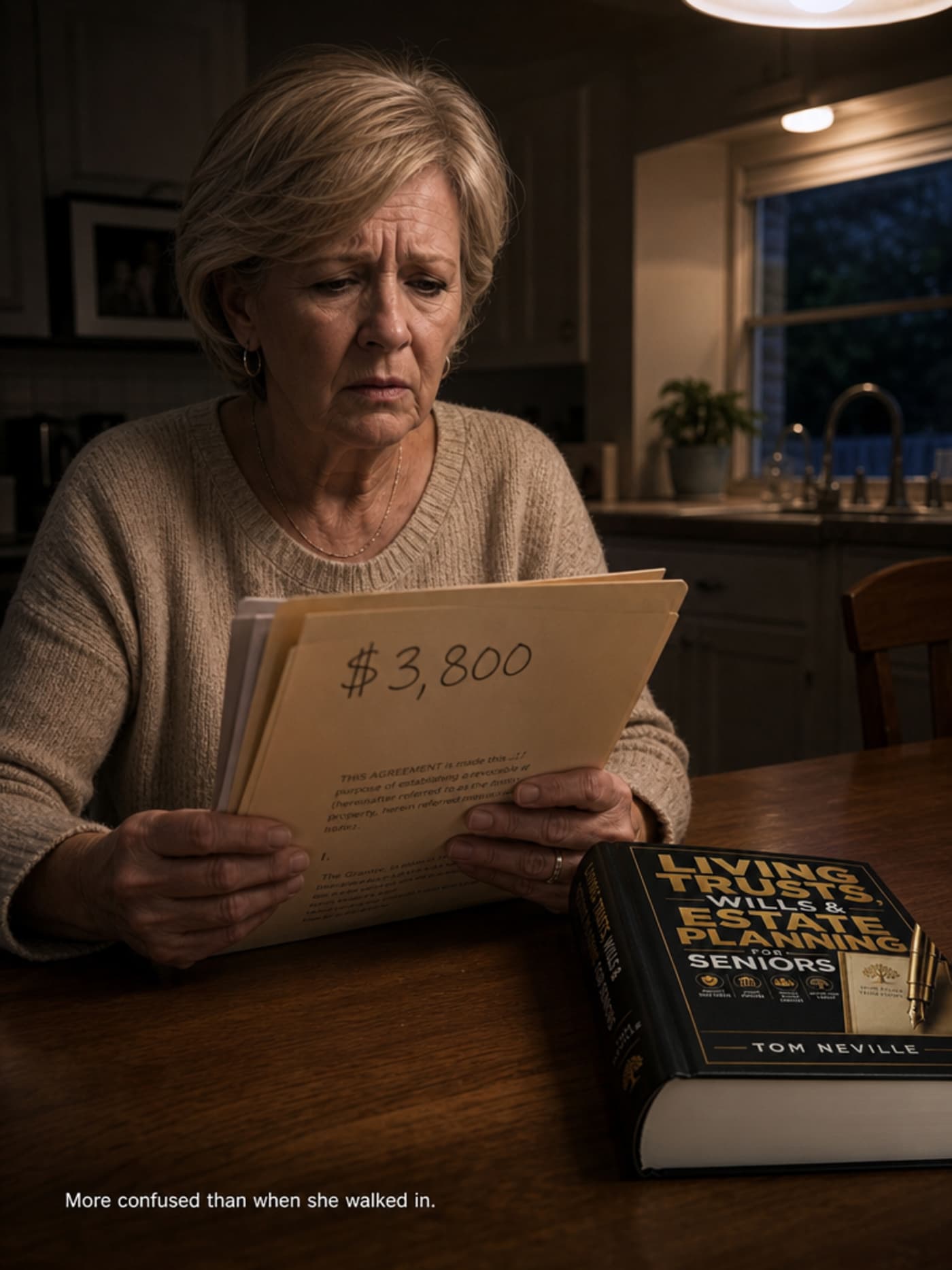
There is a specific, awful silence that happens in an attorney's waiting room after you've been quoted a number you weren't expecting.
It isn't just the dollar figure. It's that the dollar figure came with a fog. You sat across from someone who knows the material completely and explained it in terms that only made sense if you already knew them — and now you're sitting with a folder, a figure, and the nagging suspicion that you've just been prepared to be confused again at the next appointment.
Margaret's attorney wasn't dishonest. He knew exactly what he was doing. The problem is that what he was doing, in part, was billing for explanations — and the explanations assumed a baseline she didn't have. Every follow-up question would have cost her another piece of a $350-an-hour hour.
That's not an unusual situation. "Every estate attorney consultation left me more confused than when I walked in," as one reader described it — and "attorneys asked me upwards of $3,000 to even begin planning." The money and the confusion aren't separate problems. They are the same problem: a system built to charge you for comprehension you could have arrived with.
What makes estate planning specifically brutal for this is that the stakes are high enough that you can't just Google your way to confidence. You need a complete, ordered picture — not thirty browser tabs that each assume something different about what you already know. The confusion isn't a failure of intelligence. It is a structural consequence of trying to learn a legal topic sideways, in fragments, under the quiet pressure of knowing it actually matters.
The point of entry into this guide isn't "here is what a trust is." It is: here is why you didn't understand it before, and here is the one path through it that makes sense without a law degree. "Finally, estate planning that doesn't require a law degree to understand," as a reader described the experience of finally reaching something legible. "The antidote to that anxiety."
That path begins — and this is the part most estate guides skip — with understanding exactly what a will can and cannot do. Because for most people who've been paying for attorney time, that distinction is where the whole costly misunderstanding starts.
A Will Goes to Probate. That's Not an Accident — That's What Wills Do.
Here is the thing Margaret's attorney did not say clearly, and the thing most estate guides mention once in passing and then spend two hundred pages discussing something else:
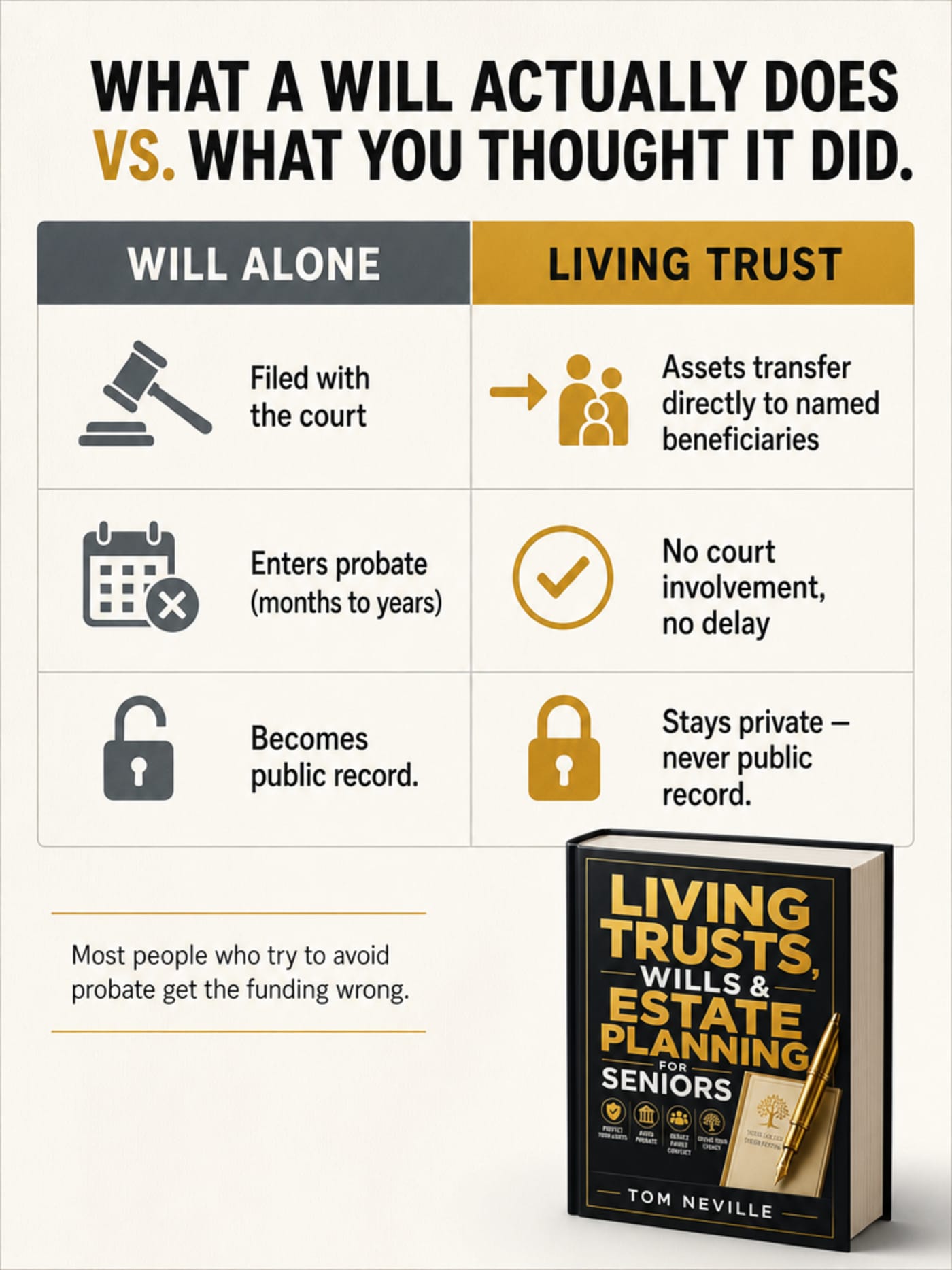
A will does not keep your estate out of the courts. A will is a legal instruction to the courts. Those are not the same thing.
When a will is filed — when someone dies and their executor presents that will to the appropriate authority — it enters what is called probate. Probate is the court-supervised process of validating the will, identifying the assets, paying any debts, and distributing what's left. It takes time. In straightforward cases, months. In contested cases, years. And while it is happening, the estate's assets are typically frozen: accounts inaccessible, property untransferable, decisions waiting on a court calendar.
There is one more detail about probate that most people don't discover until it's their family going through it: it is public record. The will, the asset inventory, the debts, the distribution — all of it becomes a matter of public record in the county courthouse. Anyone can find it. "Pass my property on to my family without [the state] drooling on it" — that is how one reader named what they were actually trying to protect against, and the language is blunt because the fear is real.
A revocable living trust works differently. Assets held inside a properly funded trust pass directly to the named beneficiaries, outside of probate, outside of the courts, and outside of the public record. Private. Fast. In the family. The trustee distributes according to the trust's terms without waiting for a judge's schedule.
The phrase "avoid probate" appears in nearly every estate planning book on the market. The reason it keeps appearing is that most of those books mention it without explaining the mechanism — and the mechanism is what actually changes anything. "You don't avoid probate by wanting to — most who try get the funding wrong," as one reader discovered after reading a more complete account of the process. Understanding it requires knowing not just that a trust avoids probate, but how a trust is properly set up and funded so that it actually does.
That "how" is where most guides fail. And that gap between the promise and the mechanics is exactly what determines whether the plan your family receives is one that protects them or one that still, despite your best efforts, ends up before a judge.
The difference between an unfunded trust and a properly structured one — that's the next piece, and it leads somewhere most estate guides don't go.
Six Years of "I'll Get to It" Is a Plan — Just Not the One You Wanted
There is a particular kind of procrastination that doesn't come from laziness.
It comes from a task that carries real stakes, has real complexity, and every time you sit down with it, it does something ordinary tasks don't do: it makes you feel worse. You pick up the legal guide. You read about revocable and irrevocable instruments. You start to feel the way Margaret felt in the attorney's office — like you're missing something foundational, like understanding this would require becoming a different kind of person first.
So you close the book. And next year you'll get to it.
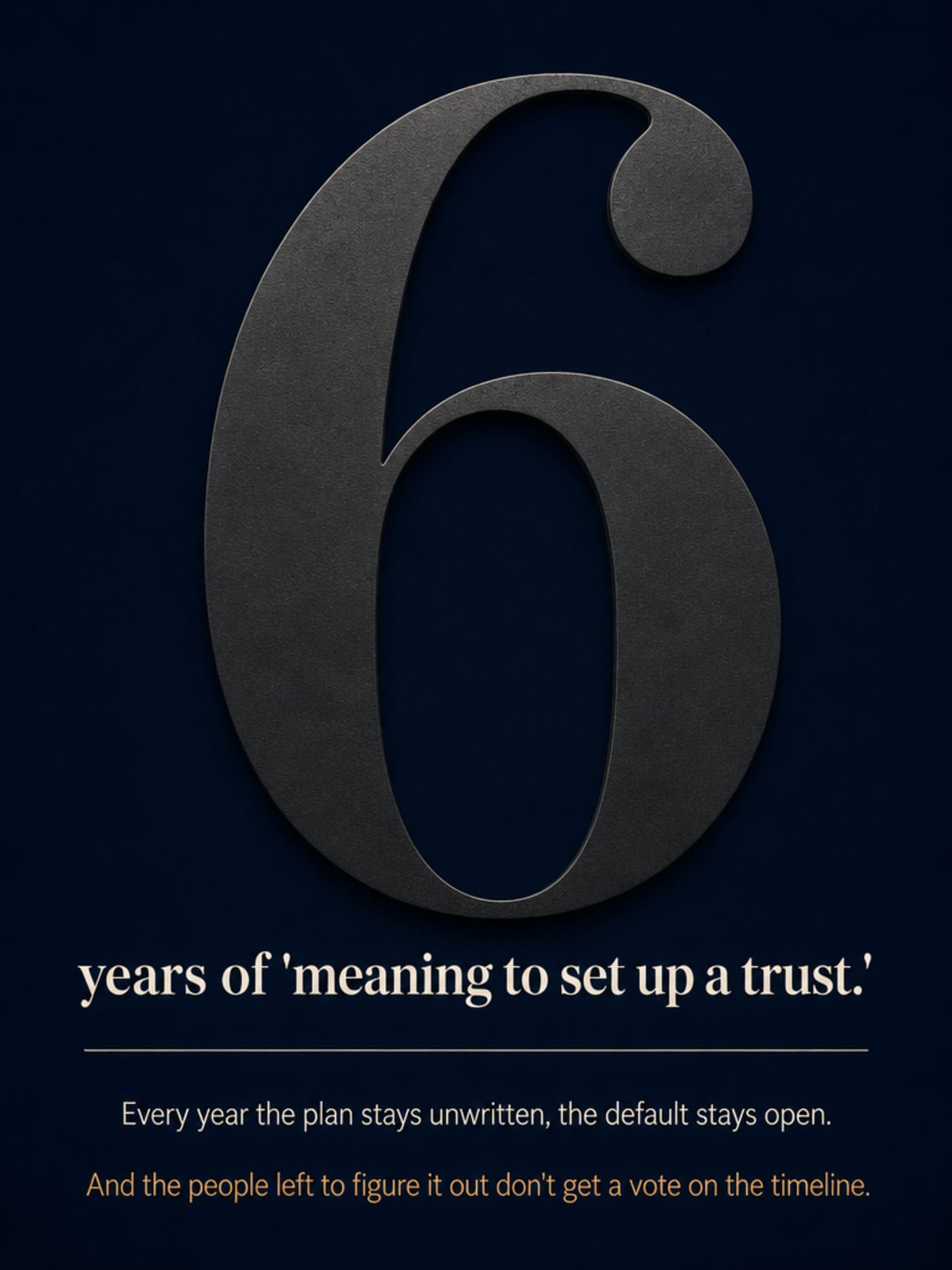
"I've been 'meaning to set up a trust' for six years," one reader wrote. Not six weeks. Six years. That's not a coincidence or a character flaw — it is what happens when a high-stakes topic is systematically explained in language that makes people feel less capable each time they engage with it. The jargon doesn't just confuse. It discourages. It produces the specific paralysis of the capable adult who has done hard things before and yet cannot seem to start this one.
What breaks that paralysis isn't urgency. Urgency has been tried — the estate planning category runs on vague mortality anxiety, and it hasn't moved the needle for the six-year stallers. What breaks it is legibility. "Every estate planning book I'd picked up either read like a legal brief or assumed I already knew the difference between revocable and irrevocable trusts." When that changes — when the material finally explains itself instead of expecting you to decode it — the calculus shifts. "A weekend at the kitchen table" is how one reader described what happened once the information was actually accessible. That is not an exaggeration of how fast it can move; it is what happens when the obstacle was never the task itself, but the presentation of it.
For the purposes of this guide: the procrastination is not your problem. It is the category's problem. Every year an estate plan is deferred, the gap between "what you intended" and "what happens by default" remains open — and it is the people who inherit that gap, not the person who delayed, who pay the price for it.
That price — what it actually costs the people left behind — is the part most guides discuss in the abstract. It deserves something more concrete.
"I Was Terrified I'd Start a War" — The Blended-Family Parent's Quiet Dread
Robert has not talked about this to his children.
He has two from his first marriage — both adults, both fond of him, both with a reasonable expectation of inheriting whatever he leaves. He also has a stepchild from his second marriage, who came into his life at twelve and is now, by any honest accounting, as much his family as the others. Robert loves all three. He does not know, with legal confidence, how to make the distribution work in a way that everyone can accept — or how to prevent the resentment that accumulates, quietly and without his control, in the years after he's gone.
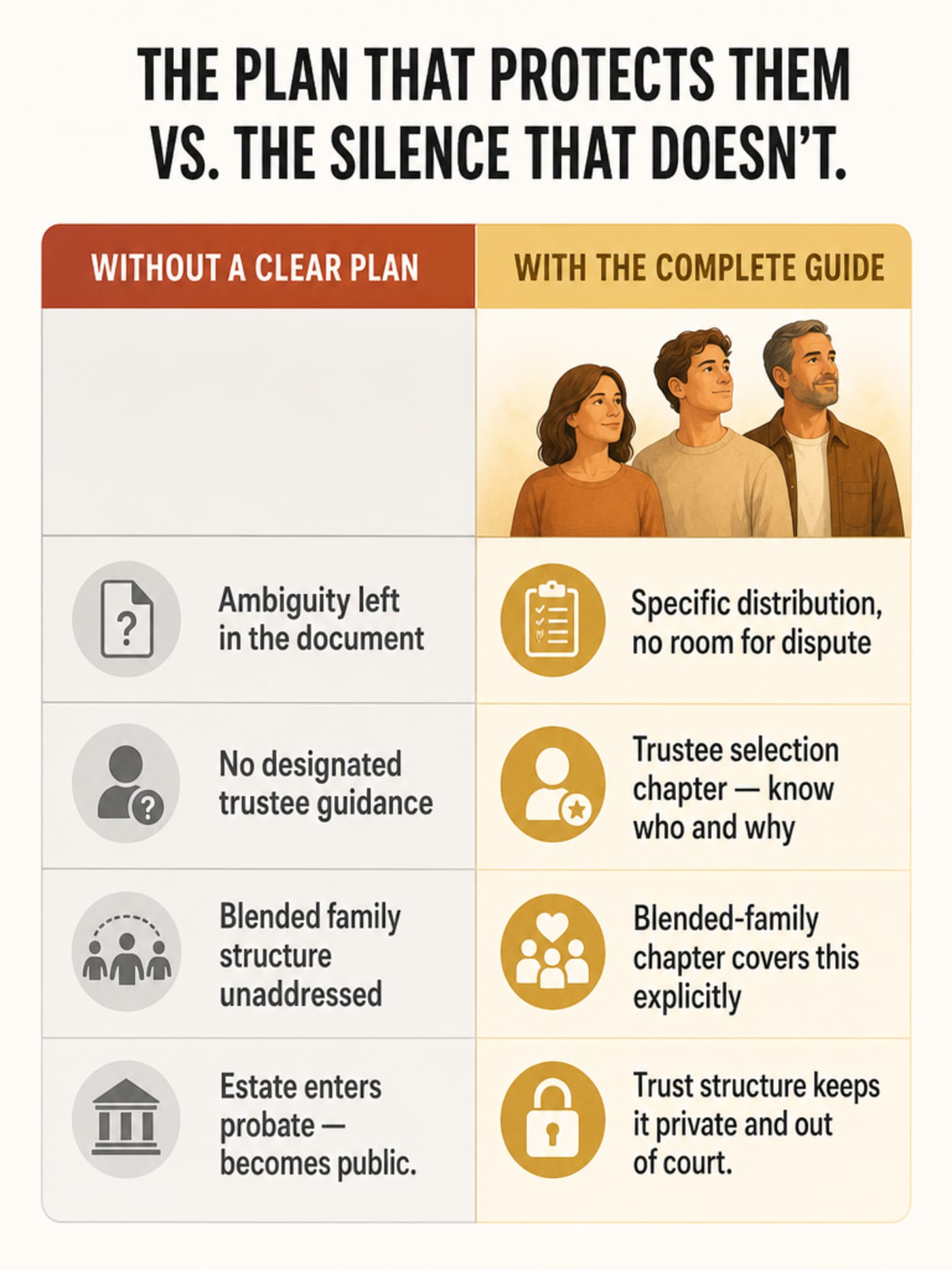
"My kids, my stepkids, one estate — I was terrified I'd start a war," as one reader named this exact situation, precisely. "The blended-family chapter fixed that."
What most estate guides miss about family conflict is that it rarely starts as conflict. It starts as ambiguity — a will that wasn't clear, a trust that was never properly funded, an executor who didn't know what they were doing and had to make judgment calls in grief. Families that split over an inheritance didn't do so because they were cruel people. The plan allowed them to — and the absence of a good plan is not neutral, it is a gift to disagreement.
A properly structured estate plan doesn't just name who receives what. It names the trustee with enough information to choose well. It accounts for specific family structures — blended families, dependents who need ongoing care, digital assets no one thought to address. It closes the doors that, left open, become the rooms where the fighting happens.
The beneficiaries in Robert's scenario — his children, his stepchild — are not passive recipients of whatever document he files. They are the people who will live inside the structure he creates, or doesn't create, for the rest of their relationship with each other. The gift isn't the assets. "The last gift you give them is not having to figure it out."
That gift is specific and made from specific decisions. And the most important decision in any estate plan — the one that determines whether everything else holds — is one that most people making their first plan get wrong in a way they don't discover until it's too late to fix.
"There Are No Will and Trust Forms in This Book" — How the Category's Biggest Lie Became the Easiest Thing to Fix
There is a sentence that appears in the one-star reviews of estate planning books with remarkable, dispiriting regularity.
"THERE ARE NO WILL AND TRUST FORMS IN THIS BOOK." Capitals. Because the reader had been told there were. Because the QR code on page 187 resolved to a landing page, which asked for an email address, which sent a confirmation, which never arrived — not in the inbox, not in spam, not anywhere. "I have received nothing," as one reader described the experience. "Not in my inbox and not in spam."
The forms-that-never-arrive is the category's signature failure. It is also its most revealing one, because it tells you everything about the relationship between reader and publisher: the forms are promised as a closing argument — proof that the book is practical, not theoretical — and then treated as a cost center the publisher would rather not deliver. The reader is left with an explanation of why forms matter and no forms.
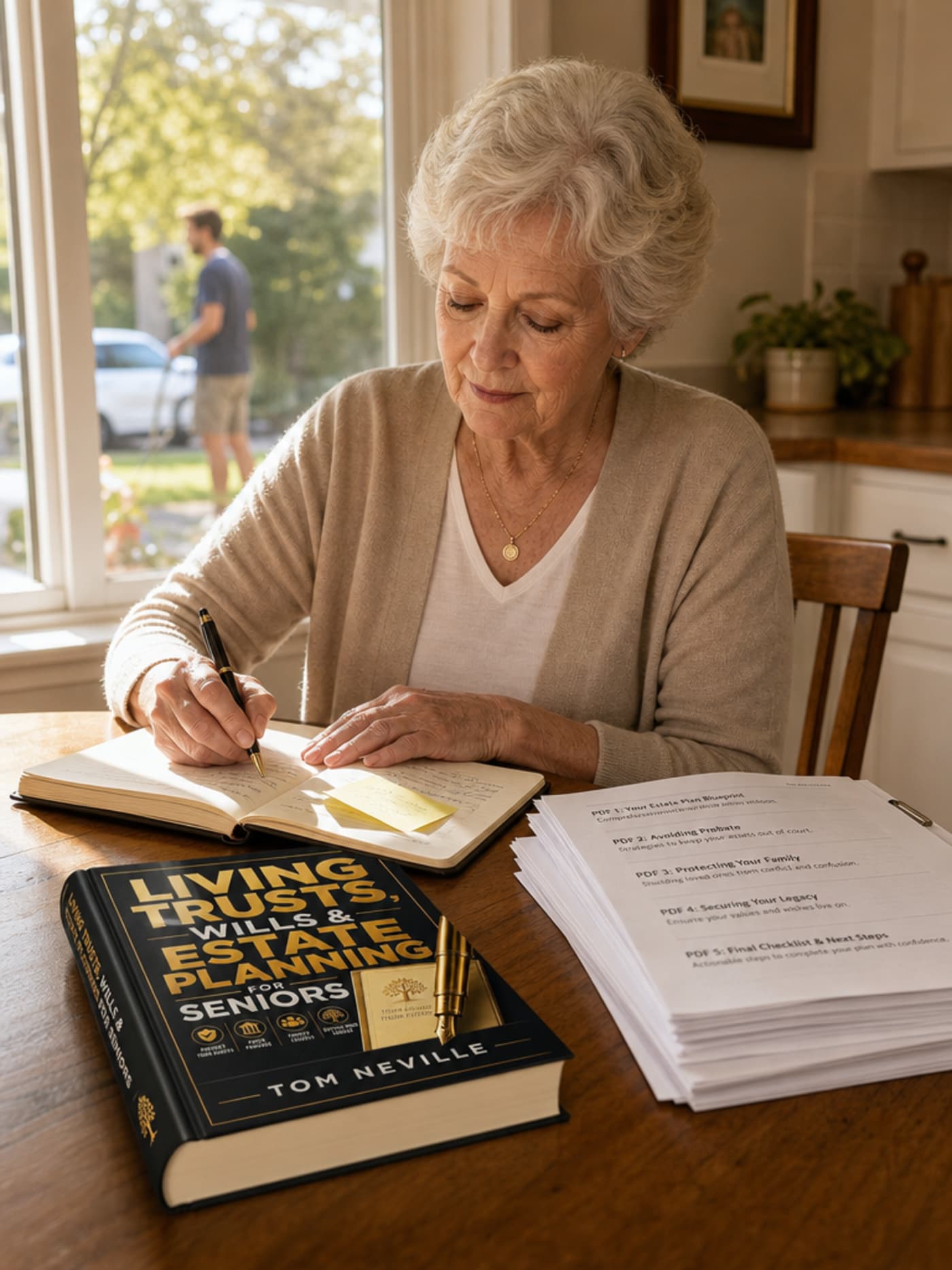
This guide includes five PDFs. Not a QR code pointing to a form-shaped absence — five PDFs, delivered with the purchase, containing the documents the guide explains. A will template. A trust document. A power of attorney. A trustee guide for whoever you choose. An estate planning checklist. The forms are the point. The text exists to make them usable.
The audiobook exists because "the law books I attempted to read confused my head" — and because "attempted to read" is how a significant number of readers describe the estate planning books they own. The audio format is not an add-on. It is the recognition that the material needs to be heard as well as read, and that for anyone whose eyes give out before the end of chapter three, an audiobook isn't a luxury.
This is also the guide written by Tom Neville — a named author, not a pen name for a writing team, not a byline generated by a process. "Garrett Monroe is a pen name — I could not find any verifiable credentials," as one reader discovered about the category's bestselling title. That specific dread — buying something important from someone who may not exist — is what a named author resolves. Not the credentials on the wall; the willingness to put a name to it.
The five PDFs don't replace an attorney. Neither does this guide. What they do is put you in the position Margaret is in now: walking into any conversation about her estate as someone who knows what she's looking at, knows what questions to ask, and knows — because she has the documents in front of her — what a proper plan actually looks like.
What Readers Are Saying
"I've picked up at least three estate planning books over the years and never made it past the first few chapters. This one I actually finished — and I understood it."
Patricia H. · Phoenix, AZ
"Finally something that explains the difference between a will and a trust in plain language, without assuming I already knew the terminology. Practical and clearly organized."
D. Mercer · Columbus, OH
"I was dreading this whole process. Having the actual forms included — not a QR code, the real documents — made it feel manageable. Exactly what I needed."
James R. · Tampa, FL
The Attorney's Fee Was the Easy Part to See. The Confusion Was the One That Cost Her.
Margaret left that office having paid nothing yet — the quote was for future work. But she had already paid something: months of delay, a folder she couldn't use, and the nagging sense that she was one unexpected event away from her estate being sorted out by a court on someone else's schedule.
That is the invisible cost of staying where the confusion found her. Not the $3,800. The months of not acting because the material was too opaque to act on. The blended-family question Robert hasn't resolved. The children who will receive either a clear plan or a frozen probate estate, depending entirely on decisions made at a kitchen table that keep getting postponed.
Here is what a reader who finishes this guide walks away with:
- A clear picture of what a living trust actually does — not in legal language, in plain English, start to finish.
- An understanding of why a will alone doesn't avoid probate — and what a properly funded trust requires to actually work.
- The five real forms — will, trust, power of attorney, trustee guide, planning checklist — delivered with the purchase.
- A blended-family framework that closes the gaps most people don't know are open until they're too late to close.
- The preparation to walk into any attorney's office, any financial conversation, or any family discussion about the estate as someone who knows what they're looking at.
The guide doesn't ask anyone to skip the attorney. It asks: what would it be worth to walk in already knowing what you need — instead of paying, by the hour, to be taught it?
The plan Margaret needed has been sitting in plain English, with the forms, this whole time.